
Sperm Retrieval Techniques in Men with Klinefelter Syndrome



Klinefelter syndrome, a genetic disorder found in men, impacts sperm production, often leading to difficulties in conceiving. Men with the 47,XXY chromosome configuration may live their entire lives without recognizing this condition, as long as no symptoms manifest. The fertility issues in men with Klinefelter syndrome arise due to underdeveloped testicles, a result of the genetic disorder, and the consequent deterioration of the sperm-producing tubules within the testicles. Most men with Klinefelter syndrome experience azoospermia, meaning they have no sperm in their semen, and thus cannot father children naturally. It's common for many men with Klinefelter syndrome to discover their genetic condition through chromosome analysis when they face challenges in starting a family. Today, however, men with Klinefelter syndrome have the opportunity to father children. This is achieved by extracting sperm cells directly from the testicular tissue through surgical procedures and fertilizing egg cells using a technique known as Intracytoplasmic Sperm Injection (ICSI).
Methods of Retrieving Sperm from Testis Tissue
In men with Klinefelter syndrome, since no sperm is present in the semen, efforts are made to locate sperm within testicular tissue samples obtained through surgical procedures. Tournaye et al. first reported in 1996 the successful retrieval of sperm from the testicular tissue of azoospermic men with Klinefelter syndrome. These retrieved sperm have since been utilized in in vitro fertilization (IVF) treatments.
The literature reports varying success rates using different techniques for sperm retrieval from testicular tissue. The commonly used methods include:
- TESE (Testicular Sperm Extraction): Also known as the traditional TESE method, this procedure involves randomly removing testicular tissue from various locations without magnification. The obtained tissues are then sent to a laboratory to identify sperm.
- Micro-TESE (Microdissection-TESE): First described in 1999 by Dr. Peter Schlegel of Cornell University, NY, USA, and introduced in Turkey in 2002, this microsurgical technique aims to locate sperm cells within testicular tissue. The procedure involves examining testicular tissue under an operating microscope to identify small areas capable of producing sperm. Samples from these areas are examined in a lab setting, and if sperm is found, they can be used for reproductive techniques. The sperm retrieval rate with Micro-TESE has increased from 42% to 57% compared to traditional TESE, although success rates can vary significantly depending on the surgeon's experience and the laboratory techniques employed.
- PESA (Percutaneous Epididymal Sperm Aspiration): Used for men with obstructive azoospermia, PESA involves collecting sperm cells from the epididymis, a canal system above the testicles where sperm are temporarily stored. The procedure entails inserting a thin needle into the epididymis to extract a fluid sample, which is then examined for sperm cells. However, PESA is not suitable for men with Klinefelter syndrome as the tubules inside the testicle are anatomically damaged, preventing any locally produced sperm from reaching the epididymis.
- TESA (Testicular Sperm Aspiration): TESA aims to directly extract sperm cells from the testicular tissue. This is done by aspirating tissue samples using a thin needle. The sampled tissue is then analyzed in a laboratory to isolate sperm cells. In men with Klinefelter syndrome, where sperm production may occur in very small areas of the testicular tissue, these random needle methods are not recommended due to the low probability of successful sperm retrieval
Image 1. View of testicular tissue in a man with Klinefelter syndrome under an operating microscope. With the help of x24 magnification, the canals called tubules that produce plump, enlarged sperm are collected with the help of microforceps.

Micro-TESE in Klinefelter Syndrome
Micro-TESE (Microdissection-TESE) is a surgical technique employed to retrieve sperm from men diagnosed with Klinefelter syndrome, conducted under the aid of a microscope. The operating microscope used in the micro-TESE procedure should ideally have magnification capabilities of x24 or higher.


This method aims to extract sperm cells from testicular tissue. Microscopic examination of the testicle allows for more precise detection of sperm cells within the tissues. During the procedure, the patient is under anesthesia, and a wide incision is made under microscopic guidance. This approach preserves the testicle's membrane and vascular structure, enabling thorough examination of both superficial and deep sections of the testicle.

The surgeon utilizes the operating microscope, magnifying up to x18 or x24, to scrutinize the testicular tissue and identify potential sperm-producing areas. Small tissue samples are extracted from these areas with microforceps and then transferred to a petri dish for laboratory examination. 
In the laboratory, these tissue samples are meticulously cut into smaller pieces, releasing the cells into a fluid medium. A sample from this fluid is rapidly scanned under a microscope in search of sperm cells.

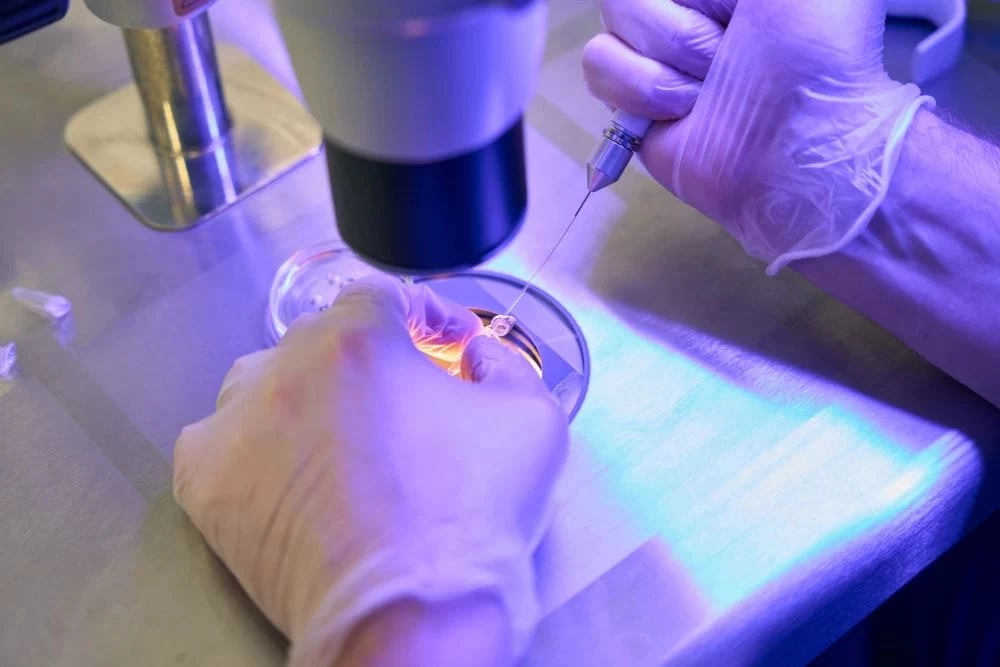
The retrieved sperm cells from the testicular tissue are then injected into an egg cell using a technique known as microinjection (ICSI), part of in vitro fertilization treatment. Post-ICSI, any remaining sperm cells are frozen and stored for future IVF procedures. Micro-TESE surgery not only enhances the likelihood of sperm retrieval from testicular tissue in men with Klinefelter syndrome but also increases the number of sperm found. This increase in sperm count boosts the chances of finding motile and high-quality sperm after freezing, storage, and thawing processes.
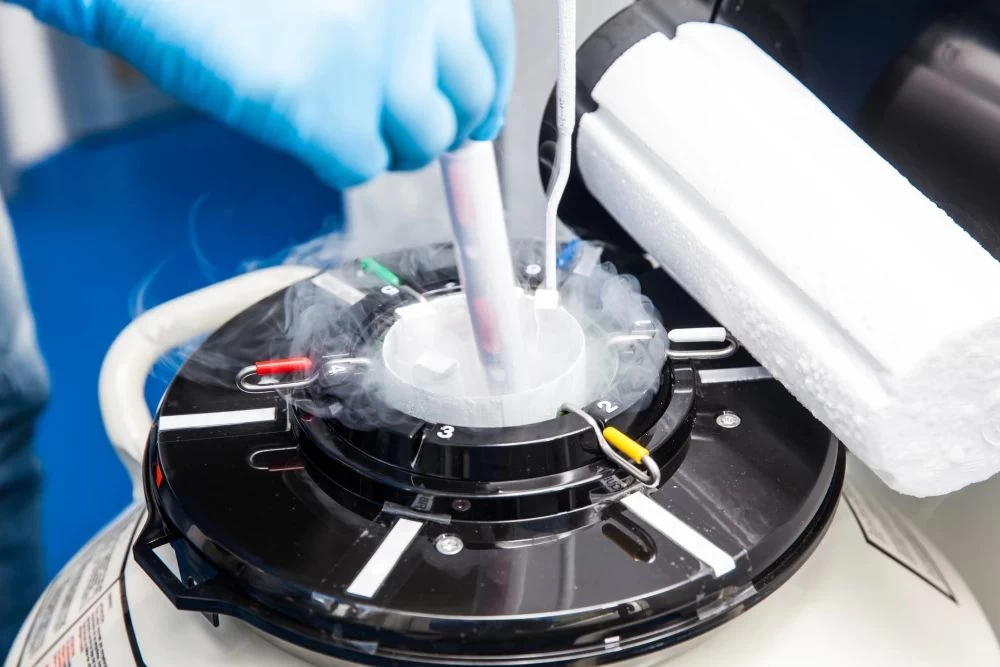
In IVF treatments, surplus sperm not utilized for egg fertilization are stored in vials within freezing tanks containing liquid nitrogen.

In Vitro Fertilization Treatment in Klinefelter Syndrome
Currently, the only way for men with azoospermia due to Klinefelter syndrome to have biological children is through surgically retrieving sperm from testicular tissue and using these sperm in conjunction with the microinjection (ICSI) method to fertilize their partner's eggs. When Klinefelter syndrome is diagnosed in an azoospermic man, couples are first counseled about the in vitro fertilization (IVF) treatment, the micro-TESE procedure, and the overall process during their initial consultation. If necessary, based on hormone tests, men may undergo controlled drug treatments for specified periods.
If the decision is made to proceed with IVF, the expectant mother's hormone treatments typically begin on the 2nd or 3rd day of her menstrual cycle. These hormone medications are used to stimulate the production of multiple eggs, a process that usually takes about 10-12 days. When the eggs reach maturity, they are collected through a procedure called egg (follicle) collection (aspiration), which is performed by reaching the ovaries with a thin needle under ultrasound guidance.
On the morning of the egg collection day, micro-TESE surgery is conducted to obtain sperm from the male partner. If sperm are successfully retrieved, they are immediately injected into the collected eggs. However, in cases where no sperm are found, the egg collection process is canceled, as per the IVF regulations in Turkey, rendering the hormonal treatments given to the woman ineffective.
To avoid the possibility of unnecessary hormone treatments for the female partner, it may be advisable to first conduct a diagnostic micro-TESE on the azoospermic man. If sperm are found, they can be frozen and stored. This process is known as diagnostic micro-TESE surgery. After the sperm are successfully frozen, the patient’s spouse can then prepare for IVF. This approach with diagnostic micro-TESE helps prevent the woman from undergoing needless hormone treatments in the event that no sperm are retrieved during the surgery.
References
- Aging may adversely affect testicular sperm recovery in patients with Klinefelter syndrome
- Sperm recovery and ICSI outcomes in Klinefelter syndrome: a systematic review and meta-analysis
- Efficacy of the second micro–testicular sperm extraction after failed first micro–testicular sperm extraction in men with nonobstructive azoospermia
- Genetic Basis of Male Infertility
- Klinefelter syndrome: does it confer a bad prognosis treatment of nonobstructive azoospermia?
